Showing posts with label Printable. Show all posts

Easter Activities


With Easter only a couple of weeks away I thought I would share these activities. These are suitable for stage one and early stage two children.

Playing With Prepositions

After introducing the key preposition lesson you may find it useful for some students to have the opportunity to have concrete, hands on experiences to reinforce the concept.

I have created some easy to prepare preposition extensions cards for such occasions. These cards are used in conjunction with items you would find in your classroom (if not they would be easy enough to find at home!).

There are five sets of six cards. Each set has a small graphic in the bottom corner to help keep the sets organised easily


Grammar Mind Map

Last year I introduced mind maps to some students. After the initial introduction I decided to use the process to revise the parts of speech with some students moving into the upper elementary classroom.

We work-shopped it together as a group and students were then encouraged to make their own in their journals.


I created a completed version (based on our little work shop) to sit next to our traditional grammar chart in our language area.


It was an interesting and fun way to revise the parts of speech.

You can find a copy HERE.

Logical Agreement Games


These games reinforce the relationships between the noun and the adjective and similarly the verb and the adverb. Children have a lot of fun mixing and matching and making silly combinations, it really appeals to the sense of humour of this age group.


Logical Adjective Game

Following the initial introduction of the adjective it's really important the child gets to explore the relationship between the noun and the adjective.


I love taking an object and asking the children to tell me as many qualities about it as possible, it really helps hone their observation skills. You can leave the object and all the words you make in a basket on the shelf so the child can revisit the exercise again.


It is also good to have a set of nouns and adjectives for matching on the shelf for the children to sort through and discuss which ones fit best together. Sometimes they have an adjective left that doesn't really match the remaining noun, so they have to re-think the other pairs - hence the name Logical Adjective Game.


They can also use the set to pick out as many adjectives to describe one noun.

You can find a set of cards HERE

Logical Adverb Game

After introducing the adverb the children should have opportunities to experiment with how it works with the miniature environment.


It is fun to look at the ways the adverb interacts with the verb.


This works the same way as the Logical Adjective Game - seeing which pairs work best, making up silly pairs of words and choosing as many adverbs that can be used with a particular verb.


You can find a set of cards HERE.

Logical Agreement Games

You can play similar games with the other parts of speech as the child's knowledge and understanding grows.


You can find my series of the "parts of speech" cards for free at my TpT Store.

Studying Sharks

There has been some interest in sharks around here lately.


We looked at some shark cards that I found at the Natural Beach Living blog, which you can find HERE - there are some other fun activities to be found on that post as well. You can find more shark picture cards at Every Star Is Different, you can find them HERE.


There was some research and discussion about the parts of the shark and types of sharks.


I have previously shared my parts of the shark nomenclature for free HERE.

I created some great white shark taxonomy cards for an older child, which put all my zoology drawings to good use.


I am offering this file for FREE for a LIMITED TIME - you can find the file HERE. 


We used them with my free taxonomy title cards which you can find HERE.


I also have mute and labelled charts, definition cards and master sheet available HERE. (Note the nomenclature cards are also bundled with this pack)


It was great to see some of my reluctant readers with books open!


Montessori Monday

Follow Elementary's board Zoology Round-up on Pinterest.

Planning

This post is from September 2015:

As all teachers can appreciate, planning and record keeping are an ever-evolving process.  

This is the latest version of part of my process - weekly lesson planning. I have created a weekly template covering the main learning area's to schedule in lessons.  .


I hope to write a post further discussing planning and record keeping some time soon.

If you are interesting in taking a look you can download a copy from HERE. The file includes two blank page templates as well.

Studying the Solar System {with a Freebie}

How Small the Earth Is & The Sun's family

Children are often fascinated by magnitude of our sun and solar system and by providing them with pictures and activities that reveal the scale of the planets in relation to each other they can appreciate and grasp this concept more clearly.


As an extension of the Sun and Earth chart I have created these cut-outs of the planets to scale. The file has a black and white master set (which can be printed onto whatever coloured card/paper you prefer) as well as set with coloured planets and a control sheet.

We started with the white set which I laminated onto A4 cards - the initial focus being the different sizes of each planet. I put the name of each planet on the reverse side as a control of error. The cards can be ordered by planet sequence as well as ordered by size.


I also created the colour set, that I laminated and cut out, as a way to allow further investigation and comparison of size, by using the control chart it is easier to see which planet is which with the colour coding.


You could also cut a large yellow circle from A2 paper to include the sun to scale. There is plenty of scope to adapt these for yourself.


I also created a set of solar system Who Am I? cards that the children can use in a group, in pairs or independently. These are similar to what you might use for first knowledge of zoology or botany.


For introducing this material I find it is often best to do it in a group with children of various ages, where the older children can help the younger ones read the question cards and work together to find the answers. It is a highly engaging and enjoyable way to spark interest in learning more about the solar system. They also make a good revision exercise for older children.

You can find the Planets to Scale Freebie HERE.

You can find the Solar System Who Am I? cards HERE.

Linked to Montessori Monday

Montessori Monday

For more idea's and resources visit my Pinterest Board:

Follow Elementary's board Montessori Metaphysics & Astronomy on Pinterest.

Introducing Conjunctions

This was the lesson that made me fall in love with Montessori Grammar. It just stuck with me and it made me realise how powerful the Montessori approach can be.


Tying that pink ribbon around the flowers was such a strong image for me and it made me think back to my own schooling and how the things that stuck with me most were those that captured my imagination.

The lesson requires three flowers of different colours and begins with asking the child/ren to label the flowers, e.g. "the white flower". Once the flowers are labelled write the word "and" on two pieces of paper and place between the flower labels. Then take the flowers and tie them together with the pink ribbon and read all the labels aloud. Tell the children that the word "and" is a conjunction, placing the symbol above the "and" and then symbolising the other words.


Conjunction comes from the Latin word 'conjungere' which means to join together, which is why its symbol is the pink ribbon.

As a continuation of my word cards series for exploration, transposing and logical agreement games, you can find my conjunction word cards for free HERE.


Extensions:
After the initial lesson, children can practice with the miniature environment.

I have also created some extension cards, which are similar to the logical agreement games that the children can play with the word cards. There are four exercises for exploring how conjunctions function.


I would suggest introducing the child to the exercise by choosing two conjunctions for them and using one of the exercises with just two pictures and ask the child to choose one of the conjunctions and place it in the pink box. Then replace it with the second conjunction and ask them how it seems different to the first.


You can find these extension cards HERE at my store.


Introduction to Prepositions

I shared some photos from a recent prepositions lesson on Facebook
and wow were they popular!


This work is so much fun and you can use any objects at hand.


When writing and working with sentence strips it really appeals to the humour of the elementary children to transpose the subject and the object, reinforcing the importance of correct word usage.

It is also important that the children build their own sentences as follow up to this work.


These cards can be used to build sentences in conjunction with the other parts of speech cards, they can be used as simple single word commands or your children may choose them for spelling words.


You can find my printable file HERE.


Noun Boxes - Plural Nouns

Through noun study we introduce some of the nuances of English spelling.


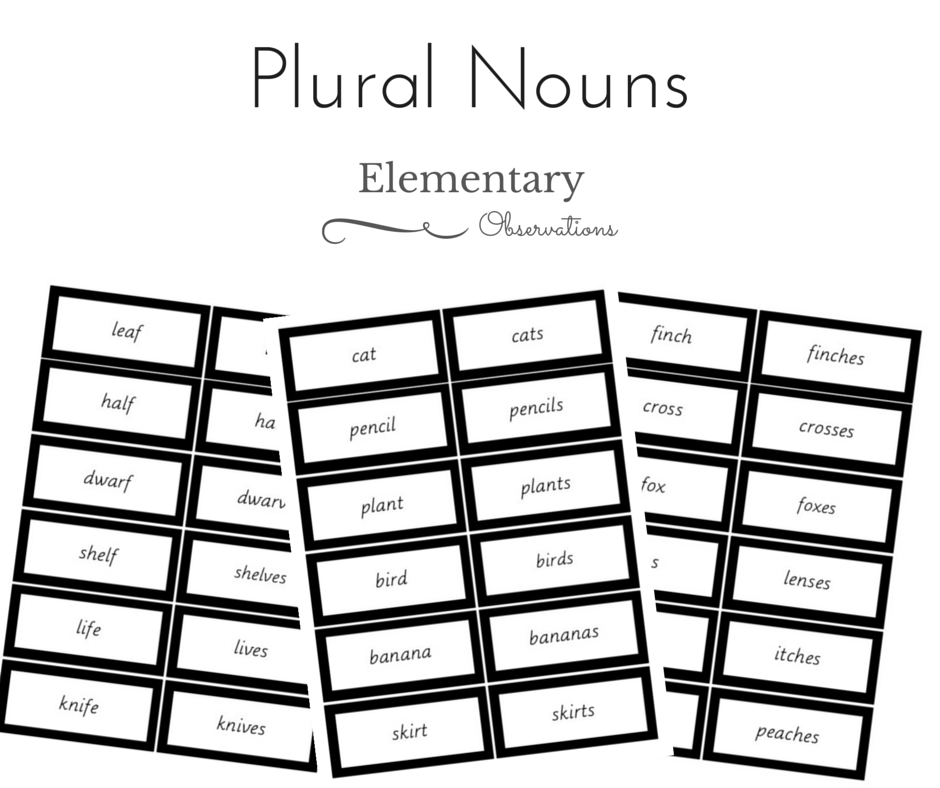
There are ten boxes for covering the rules for plural nouns. Today I am sharing the first three of these boxes.

Plural Box I - adding 's'


Plural Box II - nouns ending with a sibilant sound add 'es'


Plural Box III - nouns ending in '-f' '-fe' '-lf' that have a long vowel 'f' becomes 'v'


And be sure to enjoy some healthy discussion of the how and why the English language has evolved the way it has :)

You can purchase the full range word cards for plural nouns at my store.

See more grammar and language on my Pinterest board:

Follow Elementary's board Montessori Language on Pinterest.

Vocabulary Building

Spelling words should definitely be student driven, and many of my colleagues like to balance a selection of student driven words with words that are immediately meaningful to them - words from their prepared environment.

This integration of language and all of the other learning areas is a fundamental aspect of the cosmic curriculum at work. No learning area is in isolation of another, they are all connected, and language is the key to all learning.


I have created some cards with vocabulary words from the various learning areas to incorporate into the classroom. They could be printed onto coloured card, but I prefer plain white for spelling. Although they are grouped by learning area, I am taking a selection of words from each area based on what various children in the class are working on and placing them on the shelf (I have a box earmarked to house them in but I am also considering a clear canister for this purpose as well). Alternatively they could all be put in a large jar, like fishbowl words, for children to choose freely.

A fun activity, especially as a start of the year team building exercise, is to take a selection of words that would be good to act out, place them in a jar or box and invite the children to play charades.

These lists are primarily targeted for upper elementary, but lower elementary children may also benefit from incorporating these words into their spelling repertoire. I think the children also benefit from this as it may act as a form of revision and can lead to discussion and spark a re-interest in some learning areas.


Please note in the biology set that both protista and protoctista appear - please choose according to which your class follows.

Language list, Math list, Geometry list, Biology list, History list and Geography list

What do you do in your elementary learning environment to enrich spelling and vocabulary?

Collective Nouns

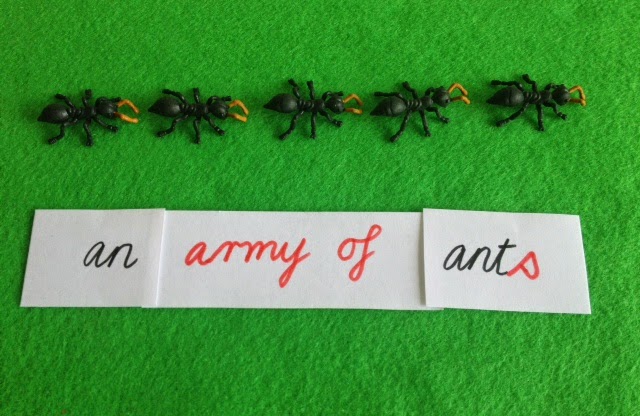
Sometime after discussing concrete and abstract nouns, and possibly even after discussing masculine and feminine nouns, the child can be introduced to collective nouns.

Invite the child to identify an object (have something prepared that you have several of) and briefly revise nouns and how everything has a name.


Then introduce the collection of items.


Some children may want to keep going with this work as they may enjoy matching the collective noun with the noun.


You can find my collective noun cards HERE and in list form HERE. You could use the list as the control of error (alternatively you can write the animal type on the reverse side of the animal card before laminating).


I think it is also important, either in the same lesson or in a follow up, to illustrate that collective nouns are not limited to animals (although they are often the more interesting examples). There are fleets of ships, bouquets of flowers, bunches of bananas and so forth. The children often have a lot of fun exploring the language of collective nouns and many will want to research more examples.


You may also be interested in THIS POST