Notes on Spelling

I was recently asked by a reader "What comes after green in the pink/blue/green series?". I will be honest, I was (momentarily) stumped. Mostly because I was not trained in PBG - so trying to wrap my head around that paradigm took a few moments. Also the idea that spelling occurs in a linear fashion did not really compute in my mind, as it is the result of reading and writing. So many experiences contribute to this ability.

So I thought I would expand a little on my answer to that reader here and share my thoughts and ideas with you all.


To me regardless of what type of learning environment - Montessori or otherwise - spelling cannot occur in isolation. My feeling is that spelling for spellings sake is counter-intuitive. When I began my studies what really resonated with me about elementary Montessori was the integrated approach, what we call cosmic education, in which learning is fostered. We, as the guide provide, children with the keys to self learning.

The transition from phonetic to non-phonetic words is developed and supported in many ways, including but not limited to:
  • orthography folders
  • studying the parts of speech - e.g. noun studies include the spelling rules for plurals and gender
  • etymology - which happens across all learning areas
  • word study - prefixes, compound words, etc.
  • providing individualised strategies based on the needs of each child
  • individual spelling dictionaries generated by the child (words of interest, words of difficulty)
Spelling is the natural consequence of reading and writing and should be:
  • student driven
  • not regimented into a meaningless task
  • made interesting through etymology, history and stories
  • connected to other learning areas
  • connected to the child's interests
Setting arbitrary words for an end of week quiz cultivates competition and impedes  lasting understanding of spelling concepts.

I see and hear of other teachers who implement various spelling programs, something I would be reluctant to do unless I felt it benefitted a particular child and it could be implemented in a Montessori way.


Related posts:

Plural Nouns

Vocabulary Building

More articles:

Spelling in the Montessori Upper Elementary Classroom - NAMC

Elementary Spelling and Research Writing - MTIPS - transcript


Introduction to Prepositions

I shared some photos from a recent prepositions lesson on Facebook
and wow were they popular!


This work is so much fun and you can use any objects at hand.


When writing and working with sentence strips it really appeals to the humour of the elementary children to transpose the subject and the object, reinforcing the importance of correct word usage.

It is also important that the children build their own sentences as follow up to this work.


These cards can be used to build sentences in conjunction with the other parts of speech cards, they can be used as simple single word commands or your children may choose them for spelling words.


You can find my printable file HERE.


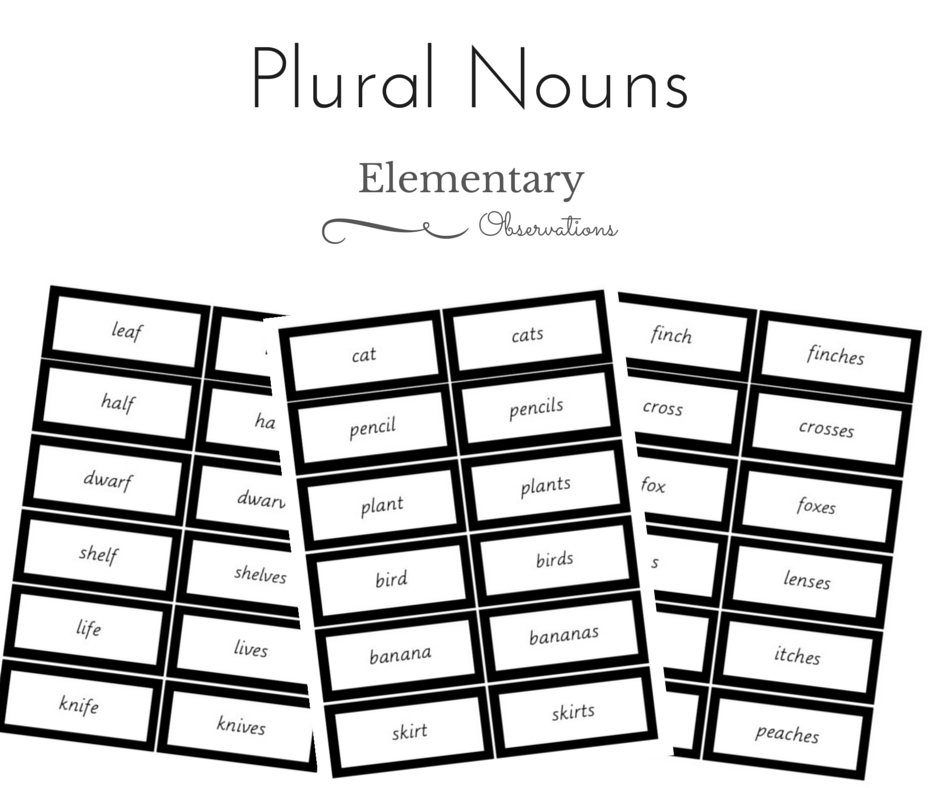
Noun Boxes - Plural Nouns

Through noun study we introduce some of the nuances of English spelling.


There are ten boxes for covering the rules for plural nouns. Today I am sharing the first three of these boxes.

Plural Box I - adding 's'


Plural Box II - nouns ending with a sibilant sound add 'es'


Plural Box III - nouns ending in '-f' '-fe' '-lf' that have a long vowel 'f' becomes 'v'


And be sure to enjoy some healthy discussion of the how and why the English language has evolved the way it has :)

You can purchase the full range word cards for plural nouns at my store.

See more grammar and language on my Pinterest board:

Follow Elementary's board Montessori Language on Pinterest.

Vocabulary Building

Spelling words should definitely be student driven, and many of my colleagues like to balance a selection of student driven words with words that are immediately meaningful to them - words from their prepared environment.

This integration of language and all of the other learning areas is a fundamental aspect of the cosmic curriculum at work. No learning area is in isolation of another, they are all connected, and language is the key to all learning.


I have created some cards with vocabulary words from the various learning areas to incorporate into the classroom. They could be printed onto coloured card, but I prefer plain white for spelling. Although they are grouped by learning area, I am taking a selection of words from each area based on what various children in the class are working on and placing them on the shelf (I have a box earmarked to house them in but I am also considering a clear canister for this purpose as well). Alternatively they could all be put in a large jar, like fishbowl words, for children to choose freely.

A fun activity, especially as a start of the year team building exercise, is to take a selection of words that would be good to act out, place them in a jar or box and invite the children to play charades.

These lists are primarily targeted for upper elementary, but lower elementary children may also benefit from incorporating these words into their spelling repertoire. I think the children also benefit from this as it may act as a form of revision and can lead to discussion and spark a re-interest in some learning areas.


Please note in the biology set that both protista and protoctista appear - please choose according to which your class follows.

Language list, Math list, Geometry list, Biology list, History list and Geography list

What do you do in your elementary learning environment to enrich spelling and vocabulary?

Collective Nouns

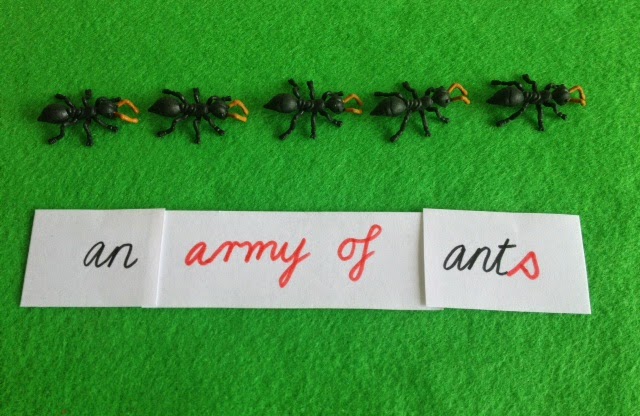
Sometime after discussing concrete and abstract nouns, and possibly even after discussing masculine and feminine nouns, the child can be introduced to collective nouns.

Invite the child to identify an object (have something prepared that you have several of) and briefly revise nouns and how everything has a name.


Then introduce the collection of items.


Some children may want to keep going with this work as they may enjoy matching the collective noun with the noun.


You can find my collective noun cards HERE and in list form HERE. You could use the list as the control of error (alternatively you can write the animal type on the reverse side of the animal card before laminating).


I think it is also important, either in the same lesson or in a follow up, to illustrate that collective nouns are not limited to animals (although they are often the more interesting examples). There are fleets of ships, bouquets of flowers, bunches of bananas and so forth. The children often have a lot of fun exploring the language of collective nouns and many will want to research more examples.


You may also be interested in THIS POST